Eliminating Ambient Authority in OpenClaw
Cryptographic policy enforcement at runtime initialization.
Design Goal
Eliminate mutable configuration as a source of implicit authority and replace it with cryptographically verifiable policy integrity at boot. This is Phase One of Crittora’s Execution Authority roadmap.
Cryptographic Policy Authority
Authority is derived from a signed, authenticated policy artifact, not editable JSON.
Fail-closed by default
If verification fails, the runtime halts. No tools initialize and no network actions begin.
The Problem: Mutable Configuration as Authority
OpenClaw typically trusts openclaw.json at startup to define tools like web_search, cli, write, and read. If that file changes, the agent’s authority changes — often silently.
- Mutable and drift-prone: Configuration can change across environments, pipelines, and deployments without cryptographic proof of authorship.
- Implicit trust at boot: The runtime accepts whatever is present at startup, creating ambient authority.
Architecture Overview
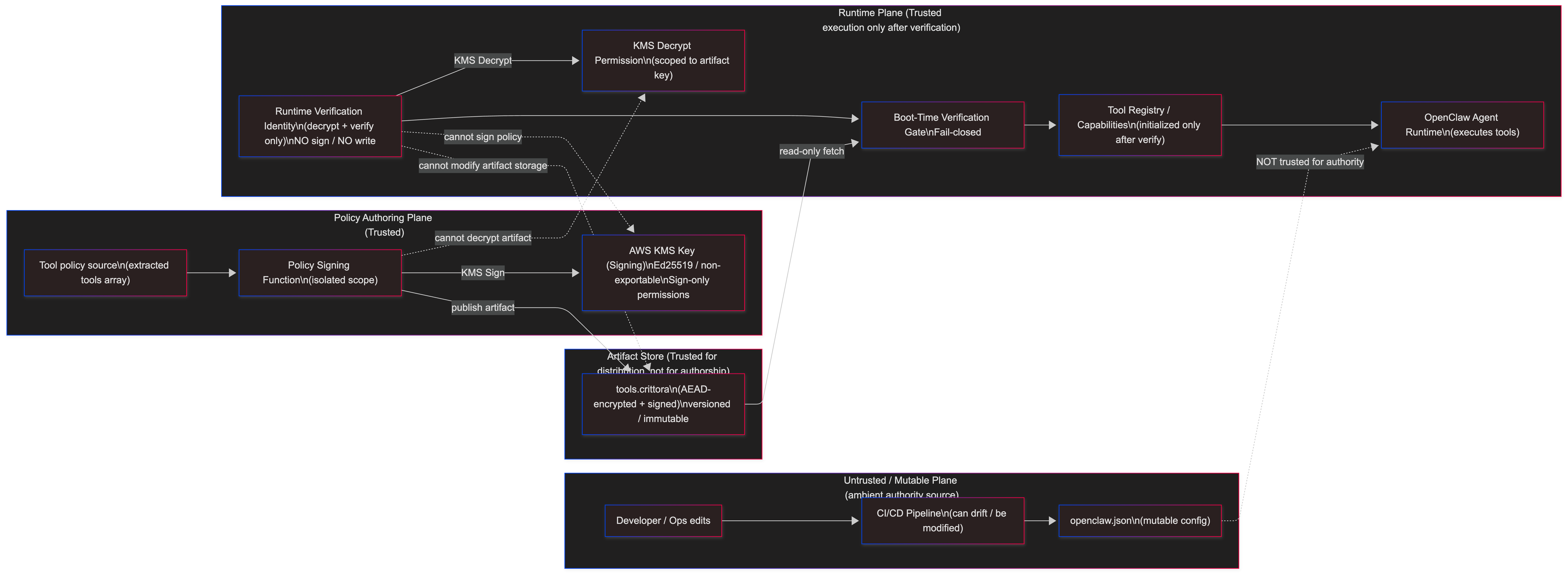
OpenClaw’s integration introduces four components that eliminate configuration trust at initialization.
Administrative signing identity
Defines and signs the canonical tool policy.
Signed & encrypted policy artifact (tools.crittora)
An authenticated, non-malleable policy package produced with Ed25519 and AES-GCM.
Agent verification identity
Can decrypt and verify policies but cannot sign or modify them.
Fail-closed boot-time verification gate
Startup halts unless the policy passes AES-GCM authentication and signature verification.
How It Works at Boot
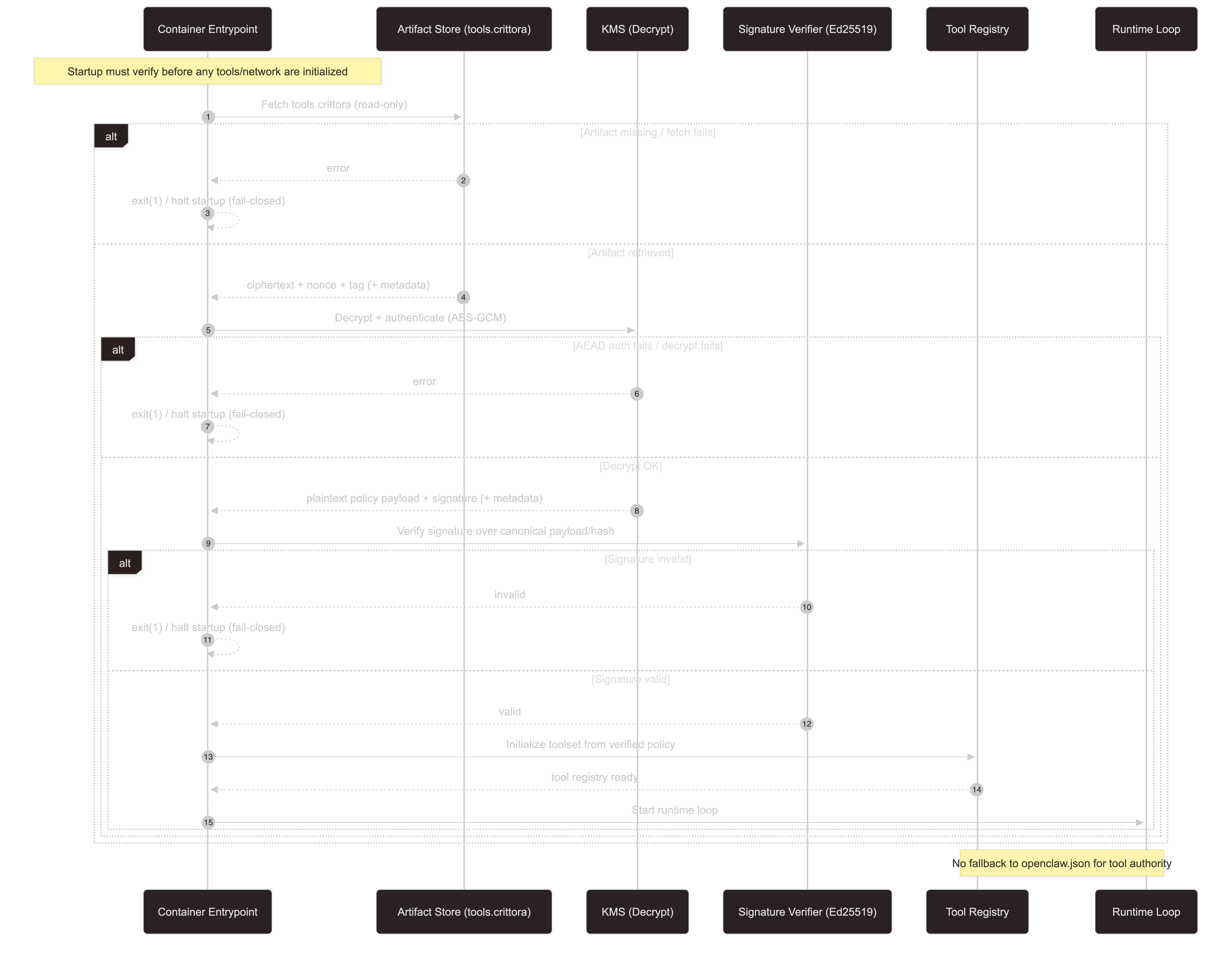
Verification happens before any tool is initialized or any network action begins.
Retrieve the policy artifact
The runtime fetches tools.crittora at startup.
Authenticate and verify
AES-GCM authentication is validated, then the Ed25519 signature is verified against the admin identity.
Fail closed or initialize
Only a verified policy is injected into runtime configuration. If verification fails, the runtime halts.
What This Achieves
Enterprise-grade guarantees at the configuration boundary.
- Eliminates configuration trust: Authority comes from a signed, authenticated artifact, not mutable JSON.
- Separation of duties: Policy authorship and policy consumption are isolated; runtimes cannot mint authority.
- Tamper detection: Any modification invalidates authentication before the policy is used.
- Deterministic startup: Boot behavior is explicit and auditable: verify, then run — or halt.
What This Does Not Do (By Design)
This integration addresses authority at the configuration layer. It does not replace runtime security or per-action authorization.
- Per-action execution permits
- Parameter-level cryptographic binding
- Transaction-scoped authority enforcement
Deploy OpenClaw with verified policy integrity
We’ll share the OpenClaw enforcement blueprint and help you pilot cryptographic policy authority.